Environmental and architectural acoustics, with instrumental rigour.
Survey, assessment, design and expert reports with Competent Technicians listed in ENTECA (no. 10798 and 12928). We build software for those who do acoustics, because we do acoustics.
What an Acoustics Competent Technician does
The Acoustics Competent Technician (TCA) is the professional role recognised under Italian law for sound-level measurements, acoustic impact and ambient noise climate assessments, and the passive acoustic design of buildings. ST-LINE operates in acoustics with two Competent Technicians listed in the Italian National Roll ENTECA (no. 10798, Veneto Region, and no. 12928, Autonomous Province of Bolzano): the dual registration ensures operational continuity and interregional coverage.
Why ST-LINE for acoustics
ST-LINE didn't start out as an acoustics specialist firm: it's a software and electronics development company that integrated acoustics as a specialist area, staffed by two Competent Technicians listed in ENTECA. That origin shapes how we approach acoustic work: we treat measurements as structured, versioned data, we build our own analysis tools when the market doesn't offer what we need (SoundPro), and we handle forensic cases with the rigour of those used to defending a technical dossier under challenge.
For the client this means three concrete things: full traceability of measurement data, interoperable delivery formats, and the response times of a small, direct technical team.
RaySound, our acoustic simulation engine
RaySound is the proprietary simulation engine we design room acoustics with. It is a hybrid engine: a wave solver in the modal band, a GPU ray-tracer in the diffuse band, and two capabilities that make it a design tool and not only a verification one — inverse design, which goes from the specification target to the surface treatment, and identifiability diagnosis, which states when the available data is not enough to support a calibration.
SoundPro, our acoustic analysis environment
SoundPro is the software we process measurements with: acquisitions from sound level meters of different makes in a single project, descriptors computed to the Italian standards, and the report that follows without manual steps between instrument, spreadsheet and document. Today we use it internally, on our own commissions, and it is the reason our measurements reach the client as structured data rather than as retyped tables.
We are developing it for the acoustics competent technician as the end user: anyone doing this work knows the problem of proprietary formats and of the time spent reassembling data that comes from different instruments.
Services
Acoustic impact and ambient noise climate assessment
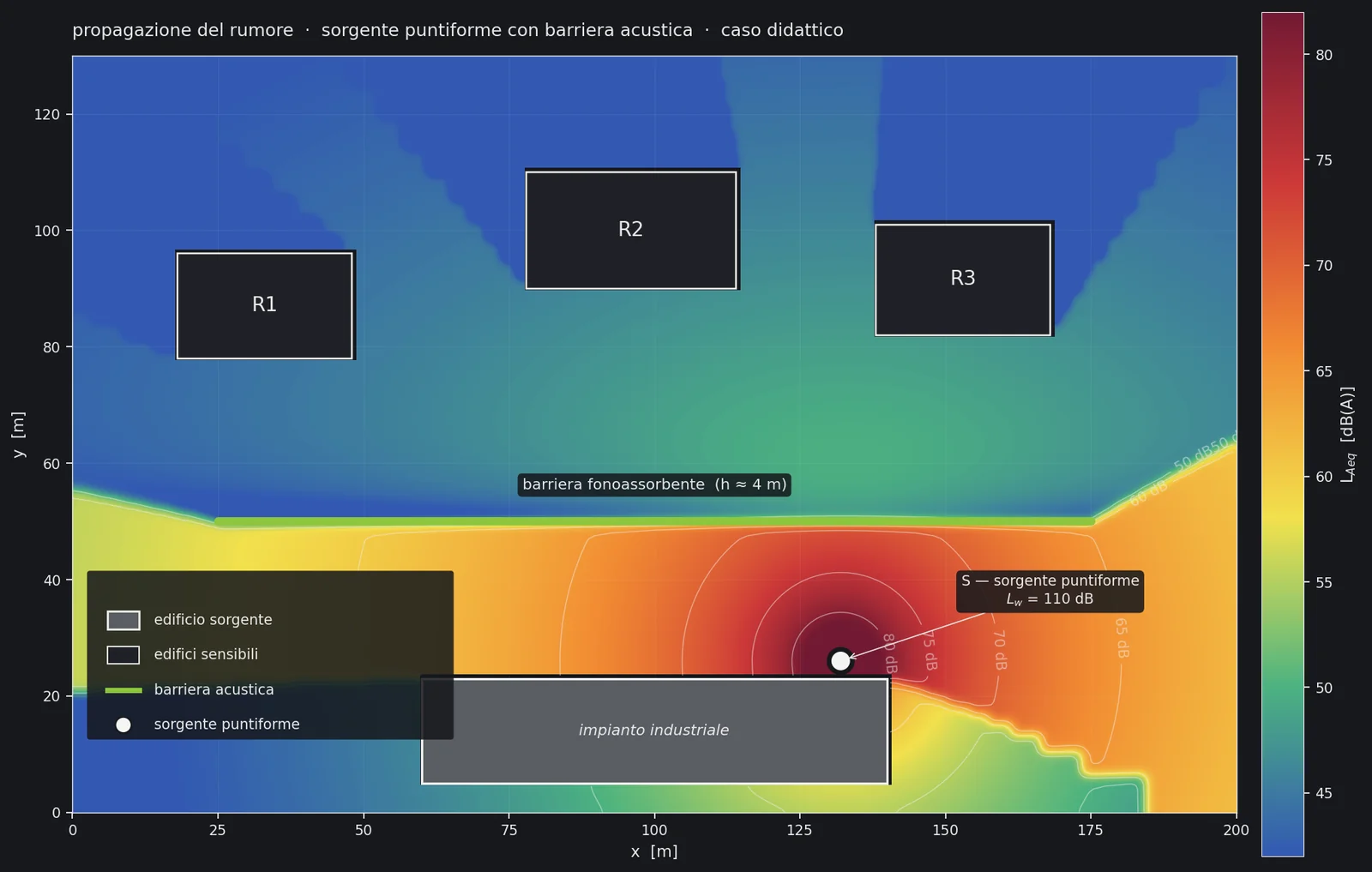
Estimation of noise emissions from fixed and mobile sources at the design and operation stages, with predictive simulations and on-site instrumental validation. Typical sectors: industrial, transport infrastructure, production activities, temporary events.
L. 447/95 (Italian framework law on noise pollution) · DPCM 14/11/97 · DM 16/03/98Occupational noise exposure assessment
Measurement of noise levels in the workplace, classification of exposed workers, mitigation guidance and PPE. Typical sectors: industrial production, construction sites, laboratories, events.
D.Lgs. 81/08 (Italian consolidated workplace safety act) · UNI 9432Passive building acoustic design
Calculation and verification of insulation, impact noise, reverberation and compliance with legal requirements. Typical sectors: residential, educational, healthcare, hospitality, tertiary.
DPCM 5/12/97 (Italian building acoustics requirements) · ISO 16283 / 717 · ISO 3382Architectural acoustics and room-acoustics design
Reverberation, clarity and intelligibility in spaces meant for listening: per-band prediction, treatment sizing and on-site verification, with our proprietary RaySound simulation engine. Typical sectors: classrooms and school environments, auditoria, conference and meeting rooms, collective spaces.
UNI 11532-1/2 · ISO 3382-1 · IEC 60268-16 · Italian CAM DM 24/11/2025 See the serviceForensic-grade sound level measurements
Instrumental measurements in environmental, occupational and architectural contexts with a signed forensic technical report. Typical sectors: condominium disputes, administrative challenges, technical consultancy for court-appointed experts.
UNI · ISO 1996 · UNI 11367Instrumentation and expertise
- Class 1 sound level meters with traceable calibration and periodic verification
- Environmental noise prediction and mapping software (ISO 9613-2, NMPB-Routes 2008, CNOSSOS-EU engines)
- Architectural acoustic simulation software (ray-tracing, image-source, reverberation analysis)
- SoundPro: our proprietary software for sound-level data analysis and reporting (see dedicated section below)
Acoustic analysis software born in the field.
Software for analysing and processing sound-level data for environmental acoustics.
We are developing proprietary software for analysing and processing sound-level data for environmental acoustics (in development). The same know-how in measurement, regulatory calculation and design moves from the field into the code — and back to technicians as a tool.
- Native import from the formats of the main sound level meters and accelerometers on the market
- Italian and European regulations integrated as versioned calculation modules
- Open project format, automatic forensic-grade traceability
The standards in force for environmental and building acoustics
Italian statutes, ISO, IEC, UNI, plus ANSI/ASTM, DIN/VDI, BS and NF: for each one the edition in force, the scope, what it does NOT cover and — for recent editions — what changed against the previous one. With the official catalogue link and the sources that decide a dispute between private parties.
Open the references ↗ISO 9613-2: a draft amendment takes diffraction back to the 1996 formulas
ISO 9613-2:2024/DAmd 1 is out for DIS ballot and rewrites D_z and K_met in Clause 7.4 again, restoring the form they had in the 1996 edition; the ISO catalogue already carries the third edition in drafting. The formulas side by side, how much the numbers move band by band, the two errata in Annexes A and B, and what it means for anyone who has to state the edition in a report.
Read the analysis ↗Tools we built for acoustics
Real client work produces open-source tools we publish so other technicians can use them. They are demonstrative — expert use needs a model adequate to the methodology and the responsibility of a qualified technician, which a program does not replace — but they embody our approach to acoustic computation.
Mappa acustica
Visualise sound-level measurements and compute propagation with diffraction on real OSM buildings.
Proto v0.6 · Open ↗Calcolo barriere acustiche
Compute sound-barrier attenuation with the ISO 9613-2:2024 §7.4 screening with lateral diffraction, or Maekawa. In development.
Proto v0.9.3 · Open ↗Composizione livelli sonori
Logarithmic sum of several sound levels and background-noise correction, with the ISO 1996-2 thresholds (UNI 9884 is withdrawn).
Tool · Open ↗Need an acoustic assessment?
Forensic-grade measurements, regulatory assessments, passive acoustic design. We reply within 2 business days.